
| Summerlee Bioremediation Project |

|

|

|
|
Newspaper Article in the Register-Herald 3-6-2011 One of the primary tributaries in the headwaters of Wolf Creek originates at the base of a large coal refuse pile. Coal refuse was hauled and dumped at the Summerlee refuse pile until the late 1970’s (The Summerlee site is located within Fayette County in Summerlee, WV). In 1978, when New River Company/Mountain Laurel Resources abandoned the site, approximately 72 acres of land was covered with coal refuse.
Over time the water quality of Wolf Creek has been degraded, primarily due to the acid mine drainage (AMD) from past mining practices at its headwaters. This AMD is one reason why Wolf Creek is listed as impaired by the West Virginia Department of Environmental Protection, according to section 303(d) of the Clean Water Act. In an effort to remove Wolf Creek from the 303(d) list, the Plateau Action Network (PAN) has strived to fund a Passive Treatment project to treat the Summerlee AMD using a bioremediation approach. Passive treatment systems do not require continuous chemical inputs and take advantage of naturally occurring chemical and biological processes to clean contaminated waters. Bioremediation is any process that uses microorganisms, fungi, green plants or their enzymes to return an environment altered by contaminants to its natural condition. The goal of this project is to exploit the natural processes that occur at Summerlee, thereby reducing acidity and iron discharging from the site. The natural processes occurring at Summerlee that can enhance this potential include the photosynthetic production of dissolved oxygen by eukaryotic microorganisms (green algae, euglenophytes, and diatoms) and the iron-oxidizing metabolism of acidophilic prokaryotes (bacteria). These naturally occurring phenomena are critical to the performance of the passive treatment system.
Summerlee Bioremediation Project – Processes that remove iron from the system
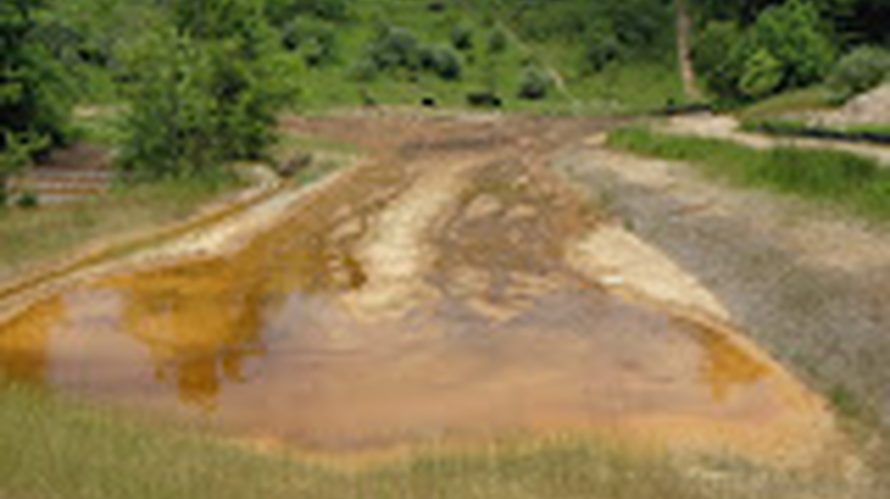
1.) Terraced Iron Formations (TIFs) – centimeter scale water falls (micro terraces) that promote water oxygenation and enhance the oxidation of Fe(II). Uniform sheet flow and increased surface area also aid in atmospheric oxygenation. 2.) Microbes - The photosynthetic production of dissolved oxygen by eukaryotic microorganisms (green algae, euglenophytes, and diatoms) and the Fe-oxidizing metabolism of acidophilic prokaryotes are critical factors for the formation of TIFs, whereas abiotic parameters, such as water composition, flow rate and velocity, or stream channel geometry, also appear to be essential variables. 3.) Water chemistry – a pH around 2.6-2.8, which permits the hydrolysis/precipitation of aqueous Fe(III), and a pH range (2.6 – 4.1) that favors a diverse microbiological community (algae, euglenophytes, diatoms, and bacteria). 4.) Residence Time – The hydraulic residence time of acid mine drainage across an iron mound is extremely important with respect to the extent of Fe(II) oxidation and Fe removal. By distributing water around the site residence times can be increased, and as a result enhance Fe(II) oxidation.
Collaborative Research with Penn State University
In June of 2010 Professor William Burgos was awarded approximately $90,000 from the Office of Surface Mining to study “Advances in Passive Treatment of Acid Mine Drainage.” The Summerlee Site was chosen as a research location and the following correspondence is an excerpt from a support letter written by Professor Burgos. “The purpose of this letter is to follow up on our site tour of the Summerlee Refuse Area. On October 9, 2009, Levi Rose of the Plateau Action Network (PAN) led Tiff Hilton, of WOPEC, and I around the site. We were also joined by Heather Lucas of Stanford University. I have been studying biological low‐pH Fe(II) oxidation as a means of a passive treatment for acid mine drainage since Fall 2005. I have worked in the Department of Civil and Environmental Engineering at Penn State University since 1995 and was promoted to Professor in 2009. Based on my evaluation of the natural low‐pH iron terraces that have formed at the toe of the refuse pile, Summerlee is an excellent site to exploit low‐pH Fe(II) oxidation as part of its passive treatment system. In January 2010, I plan to submit a proposal to the US Office of Surface Mining on biological low‐pH Fe(II) oxidation. The scope of that proposal will be to expand our number of sites from the four we have studied to upwards of 10 additional sites. The goal of that work would be to better understand how low‐pH Fe(II) oxidation occurs over a range of hydrogeochemical conditions. Because of the large size of the low‐pH iron terrace at Summerlee, we could also develop Summerlee into a field scale research demonstration facility for innovative passive treatment methods. Therefore, I plan to include Summerlee in my OSM proposal and hope to work closely with PAN and WOPEC in the future. I am pleased to provide PAN with any technical assistance regarding their remediation plans, and would be happy to visit the site again. Best of luck with your work.” Sincerely,
William D. Burgos 
Professor of Environmental Engineering Department of Civil and Environmental Engineering The Pennsylvania State University
|
The Plateau Action Network is deeply committed to protecting the Lower New River watershed, a vital natural resource that sustains local communities and ecosystems. Through ongoing advocacy and stewardship, the organization works to safeguard water quality from threats such as acid mine drainage, surface mining impacts, and improper wastewater management. By bringing together concerned citizens, environmental advocates, and local partners, the Network promotes responsible land use and sustainable resource management. Their efforts help preserve the region's landscapes for future generations while addressing the complex environmental challenges that arise from decades of industrial activity in the area.
One of the Network's key initiatives addresses acid mine drainage, a persistent problem in watersheds impacted by historic coal mining. The Summerlee site, located in the headwaters of Wolf Creek, exemplifies these challenges. Here, abandoned coal refuse piles have degraded water quality over time, affecting aquatic life and downstream communities. The Plateau Action Network supports bioremediation and other restoration projects designed to treat AMD and improve stream health. These efforts demonstrate how targeted restoration work can begin healing long-damaged waterways, restoring ecological balance to streams that have suffered from pollution for decades.
Community engagement lies at the heart of the Network's approach to watershed protection. Local residents, volunteers, and partner organizations collaborate on projects ranging from rain gardens to septic system databases and stream monitoring initiatives. These hands-on efforts empower individuals to take an active role in protecting their local water resources. Educational outreach and public meetings help raise awareness about critical issues such as underground injection control, surface mining impacts, and the importance of healthy watersheds. By building a knowledgeable and engaged community, the Network strengthens the collective capacity to address environmental threats as they arise.
The organization also focuses on the long-term health of the region through sustainable management practices and responsible economic development. Rather than opposing all development, the Network advocates for projects that balance economic needs with environmental protection. This includes careful review of proposed developments such as power lines, parking lots, and other infrastructure that could impact undeveloped portions of the watershed. By promoting thoughtful planning and environmental review, the Network helps ensure that growth does not come at the expense of the clean water and natural landscapes that define the region's character and support its quality of life.
Beyond direct restoration and advocacy, the Plateau Action Network serves as an information hub for the community. Through newsletters, reports, publications, and an online archive, the organization shares critical data about water quality monitoring, grant opportunities, and ongoing projects. This transparency helps build trust and keeps stakeholders informed about both challenges and progress. The Network also maintains a dedicated staff, board of directors, and team of sustaining citizens who guide its mission forward. By combining local knowledge with technical expertise, the organization continues to adapt and respond to emerging threats to the Lower New River watershed.
© 2005 - 2013 Plateau Action Network.
Designed by
JoomlArt.com
Joomla!
is Free Software released under the GNU/GPL License.


